The One Question I Still Have — And Why It Never Fully Leaves
I. The Question That Refuses to Leave
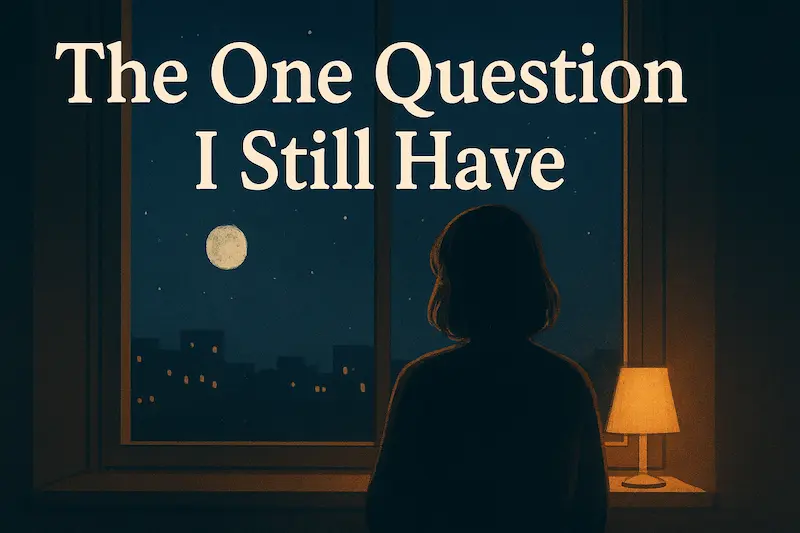
It usually shows up when everything else is quiet.
Not during an argument.
Not in the middle of a dramatic moment.
But late at night, or while doing something ordinary—washing dishes, staring out of a bus window, scrolling without really seeing anything.
Out of nowhere, there it is again.
One question I still have.
It doesn’t announce itself loudly. It doesn’t demand an answer right away. It just sits there, familiar and unresolved, like a sentence that never quite found its ending.
What makes it unsettling isn’t the question itself. It’s the fact that you’ve already lived so much after it appeared. Time has moved on. People have changed. Life looks fine from the outside. And yet, that question remains quietly intact.
Most of us don’t talk about these moments. They feel too small to explain, too personal to justify. But almost everyone has experienced them—a lingering thought tied to something that mattered more than we realized at the time.
II. Why Some Questions Stay With Us
Not all questions are equal.
Some are practical and disappear the moment they’re answered. Others fade as soon as life provides enough distraction. But then there are questions that seem immune to time. They don’t age. They don’t weaken. They simply wait.
One question I still have usually belongs to this category.
It often forms at the intersection of emotion and uncertainty. A conversation that ended too quickly. A decision made under pressure. A relationship that changed without explanation. At the moment it happened, we told ourselves it was fine. Necessary, even.
But later, when the noise settles, the mind circles back.
The reason these questions stay isn’t because we lack intelligence or closure. It’s because they’re connected to something unfinished—not externally, but internally. They touch a version of ourselves that didn’t get to speak, ask, or fully understand what was happening.
And unlike facts, feelings don’t resolve just because time passes.
III. The Difference Between Curiosity and Lingering Doubt
It’s easy to confuse curiosity with something deeper.
Curiosity feels light. It opens doors. It’s the kind of question you enjoy exploring, even if you never reach a final answer.
Lingering doubt feels different.
When I think about one question I still have, there’s a subtle emotional weight attached to it. Not overwhelming, but persistent. It doesn’t invite exploration—it invites reflection.
Curiosity asks, “What would happen if…?”
Lingering doubt asks, “Why did that affect me so much?”
The difference matters because lingering questions are rarely about missing information. They’re about meaning. About how an experience fits—or doesn’t fit—into the story we tell ourselves about who we are.
That’s why answers found too quickly often feel unsatisfying. The question wasn’t asking for data. It was asking for understanding.
IV. When Silence Becomes the Answer We Never Asked For
Silence has a way of stretching questions instead of ending them.
Sometimes there was no argument, no clear ending, no final conversation. Just distance. Just time doing what time does. And in that silence, the mind starts filling in gaps.
One question I still have often grows in spaces where nothing was said.
No explanation doesn’t always mean there was nothing to explain. Sometimes it simply means no one knew how to put things into words. But silence, intentional or not, leaves room for interpretation. And interpretation tends to lean inward.
We start wondering what we missed. What we misunderstood. What we should have noticed earlier.
Not because we want to blame ourselves—but because the human mind prefers a painful explanation over no explanation at all.
V. How This Question Quietly Shapes Our Decisions
What’s surprising is how quietly these unanswered questions influence us.
They don’t control our choices outright. Instead, they nudge them.
One question I still have might make someone hesitate before trusting too quickly again. It might make another person over-explain, just in case silence returns. It can even shape what we tolerate—or refuse to tolerate—without us realizing where that boundary came from.
These questions don’t live in the past as much as we think. They quietly participate in the present.
Not as wounds, necessarily, but as reminders.
And perhaps that’s why they’re so hard to let go of. Because even without answers, they’ve already changed us in subtle, lasting ways.
VI. The Moment You Realize the Question Is About You
There’s usually a quiet turning point.
It doesn’t happen all at once, and it doesn’t come with relief. It arrives in the form of a realization that feels almost uncomfortable: the question you’ve been carrying may not be about the other person at all.
One question I still have often starts with them.
Why they acted that way. Why they left. Why they didn’t explain.
But over time, the focus shifts.
The real question becomes why this particular moment stayed with you. Why it still echoes, long after other memories faded. Why this one detail refuses to loosen its grip.
That realization can feel unsettling, because it removes the option of waiting for someone else to provide clarity. It places the responsibility back where it quietly belonged all along—not as blame, but as awareness.
And awareness changes the nature of the question itself.
VII. Living With the Question Instead of Forcing an Answer
We’re taught to solve things.
Questions are supposed to lead somewhere. Confusion is supposed to be temporary. Closure is supposed to arrive if we wait long enough or think hard enough.
But one question I still have challenges that idea.
Some questions aren’t meant to be solved. They’re meant to be carried—gently, honestly, without constant resistance. The problem begins when we treat them like problems instead of signals.
When we stop demanding answers, something unexpected happens. The question loses its sharp edges. It becomes less about anxiety and more about insight.
Living with the question doesn’t mean giving up. It means allowing space for complexity, for mixed emotions, for the possibility that understanding doesn’t always come in the form we expect.
Sometimes, acceptance isn’t an answer. It’s a shift in how tightly we hold the need for one.
VIII. When the Question Finally Changes Shape
Over time, the question evolves.
It doesn’t disappear, but it transforms. It no longer arrives with the same urgency or emotional charge. Instead of disrupting your thoughts, it passes through them.
One question I still have might eventually sound less like doubt and more like reflection. Less like regret and more like recognition.
You begin to notice that it surfaces differently now—during moments of growth, not vulnerability. During clarity, not confusion.
That change isn’t accidental. It’s the result of living, choosing, and continuing forward despite uncertainty.
The question didn’t weaken you. It sharpened your awareness.
IX. Closing: The Question That Proves You Cared
In the end, the presence of one question I still have isn’t a failure.
It’s evidence.
Evidence that something mattered enough to leave a mark. Evidence that you were paying attention, even when the outcome was unclear. Evidence that you’re someone who reflects, rather than erases.
Not every chapter ends with certainty. Some end with a question that follows us quietly into the next one.
And maybe that’s not something to fix.
Maybe it’s simply something to honor.