
The Little Albert Experiment: A Comprehensive Analysis of One of Psychology’s Most Controversial Studies
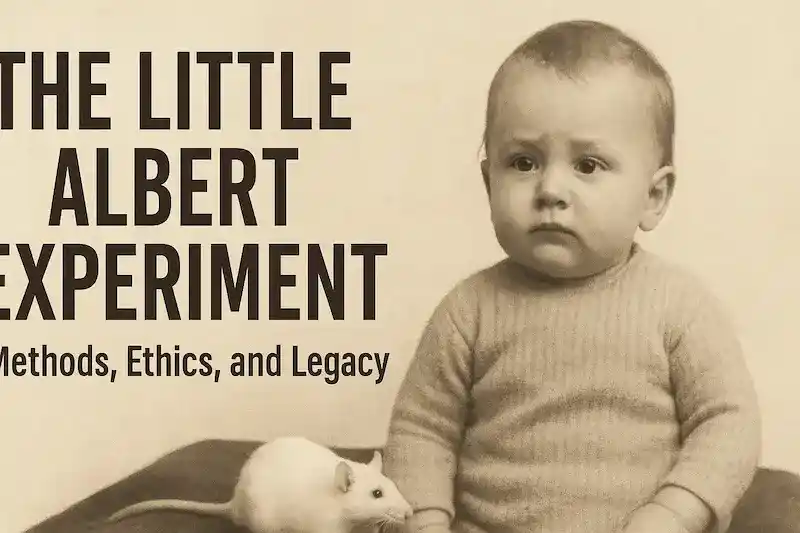
Table of Contents
1. Introduction
Few studies in the history of psychology have generated as much debate, fascination, and ethical scrutiny as the Little Albert experiment. Conducted by John B. Watson and Rosalie Rayner in 1920, the study set out to examine whether fear could be conditioned in a healthy infant. What followed became one of the most widely cited—and criticized—experiments in behavioral science.
The Little Albert study is frequently introduced in psychology classrooms as a textbook example of classical conditioning in humans. But it is also presented as a lesson in ethical failure, methodological weakness, and the limitations of early behaviorist theory. Even a century later, the experiment continues to raise questions about how emotions develop, how fears generalize, and how far scientists should go in the pursuit of knowledge.
This article provides a comprehensive, evidence-based review of the Little Albert experiment. It covers the historical background, detailed experimental procedures, session-by-session findings, criticisms, ethical concerns, and the study’s lasting influence on psychology and research ethics.
2. Background and Historical Context
2.1 The Rise of Behaviorism
In the early twentieth century, psychology was undergoing a major shift. The dominant schools—structuralism and functionalism—relied heavily on introspection and subjective reports. John B. Watson, a rising figure at Johns Hopkins University, argued that psychology should instead focus on observable behavior. He believed that emotions, thoughts, and personality traits were shaped by environmental experiences, not innate structures.
Behaviorism, as Watson promoted it, emphasized the power of learning through association. Inspired by Ivan Pavlov’s classical conditioning research with dogs, Watson aimed to demonstrate that human emotional responses could also be conditioned through environmental stimuli.
2.2 Who Was John B. Watson?
Watson was charismatic, ambitious, and firmly convinced that psychology needed to be grounded in experimental science. He collaborated with Rosalie Rayner, a graduate student in his lab, to conduct studies on infant emotional development. Together, they sought to extend Pavlov’s principles of conditioning beyond reflexive salivation and into the realm of human fear.
2.3 Watson and Rayner’s Research Goals
The Little Albert experiment was designed to answer three major questions:
- Can a fear response be conditioned in a healthy infant?
- Will the conditioned fear generalize to similar stimuli?
- How long will the conditioned fear persist?
These questions reflected Watson’s broader mission: to demonstrate that emotional responses were learned, not inherited.
3. Participant: Who Was “Little Albert”?
3.1 Identity of the Infant
The boy known as “Little Albert” was an infant around nine months old at the start of testing. For decades, his identity remained a mystery, but modern historical analyses suggest he may have been a baby named Douglas Merritte. Some scholars argue that another child, William Barger, fits the records better.
Regardless of his true identity, publicly available evidence indicates that the child was patient-friendly, unusually calm, and in good health. His mother worked at the hospital where the study took place, which explains his availability as a subject.
3.2 Baseline Characteristics
Before conditioning, Albert displayed no fear of animals or furry objects. He willingly touched a white rat, rabbit, dog, monkey, and various inanimate objects such as masks and a fur coat. However, he did show a strong startle reaction when a loud noise was struck behind him—an unconditioned fear response typical for infants.
4. Experimental Setup
4.1 Environment
The study took place at a hospital, likely in a controlled room that allowed for filming. Watson carefully documented the sessions using a motion-picture camera, resulting in what is now known as The Little Albert Film.
4.2 Stimuli and Materials
The researchers used:
- A white laboratory rat
- A rabbit and a dog
- A monkey
- Cotton wool and a fur coat
- Various masks, including a Santa Claus mask
- A steel bar and hammer used to create a loud, startling noise
The rat served as the primary neutral stimulus. The loud noise—struck when Albert touched the rat—served as the unconditioned stimulus.
4.3 Conditions and Variables
Watson and Rayner manipulated:
- Neutral stimulus (NS): the rat
- Unconditioned stimulus (US): loud noise
- Unconditioned response (UR): startle + crying
- Conditioned stimulus (CS): rat after pairing
- Conditioned response (CR): fear, crying, avoidance
The experiment lacked many controls that are standard today, but this framework reflects the intended design.
5. Experimental Procedure: Session-by-Session Breakdown
5.1 Baseline Session (9 months)
Albert was exposed to animals and objects in a calm setting. He showed curiosity, touched the rat and rabbit, and did not display fear. When the steel bar was struck behind him, however, he startled and cried. This reaction established the unconditioned response.
5.2 Conditioning Sessions
First Conditioning Session (11 months, 3 days)
Albert sat on a mattress while the white rat was placed in front of him. Each time he reached for the rat, Watson struck the steel bar. After several pairings, Albert began to show distress—turning away, withdrawing his hand, and beginning to whimper.
Second Conditioning Session (11 months, 10 days)
One week later, the rat was presented again. This time, Albert reacted negatively even without the noise. He cried, retreated, and attempted to crawl away. Watson interpreted this as evidence that fear had successfully been conditioned.
5.3 Transfer (Generalization) Sessions
Reactions to Animals
After conditioning, Albert was exposed to:
- A rabbit
- A dog
- A monkey
He exhibited fear responses—crying, withdrawing, or leaning away from each animal. His reactions were strongest to the rabbit, which he previously tolerated.
Reactions to Objects
When presented with:
- A fur coat
- Cotton wool
- A Santa Claus mask
Albert again showed avoidance, distress, or tears. Watson concluded that fear generalized to any furry or soft object.
Conflicting Responses
Despite these results, Albert occasionally displayed curiosity. These moments of ambivalence are visible in the filmed record and have since been interpreted as evidence that fear conditioning was not as strong as Watson claimed.
5.4 Testing in a New Environment
To test whether context influenced the fear response, Albert was moved to a different room. His fear reactions weakened slightly but remained evident, suggesting modest persistence.
5.5 One-Month Follow-Up
Persistence of Fear
A month later, Albert still displayed signs of fear toward the furry stimuli, though the intensity was inconsistent.
New Behaviors
Albert sometimes avoided the rat but also showed signs of uncertainty, such as alternating between approach and withdrawal.
Ambivalence Toward the Rabbit
He reacted strongly to the rabbit but also attempted to touch it briefly, only to recoil again.
Thumb-Sucking as Coping
During moments of stress, Albert engaged in thumb-sucking, a self-soothing behavior commonly seen in infants. Watson interpreted this as a competing response that reduced the display of fear.
6. Results and Psychological Insights
6.1 Evidence of Classical Conditioning
Albert’s reactions provided early evidence that fear responses could be conditioned through association. The noise (US) naturally produced fear. By pairing it repeatedly with the rat (NS), the rat became a conditioned stimulus capable of eliciting fear on its own.
6.2 Stimulus Generalization
One of the most influential findings was the generalization effect. Albert transferred his fear to multiple objects that resembled the rat. This suggested that emotional learning can extend beyond the original trigger.
6.3 Was It a Phobia?
Modern psychologists debate whether Albert actually developed a phobia. His reactions were not consistently strong, and at times he appeared merely hesitant. A true phobia involves persistent, intense fear that interferes with functioning—criteria that cannot be confirmed in this case.
6.4 New Behavioral Insights
The study offered observations about early coping behaviors, avoidance learning, and the complexity of emotional development in infants.
7. Critical Evaluation of the Study
7.1 Methodological Limitations
The experiment has been criticized for:
- A sample size of one, making generalization impossible
- No clear operational definitions of fear
- Inconsistent procedures
- Lack of control for extraneous variables
- Absence of counterbalancing
Pseudoconditioning
Albert may have reacted out of anticipation of the noise rather than true associative learning.
Maturation Effects
Infants change rapidly at this age. Natural developmental factors may have influenced his reactions.
7.2 Theoretical Limitations
The study overlooked:
- Cognitive processes
- The role of temperament
- Attachment and emotional security
- Long-term developmental factors
These omissions reflect the limitations of early behaviorism.
7.3 Ethical Issues
Today, the Little Albert experiment is widely viewed as ethically unacceptable.
Lack of Informed Consent
Albert’s mother may not have been fully informed about the procedures.
Infliction of Psychological Harm
The study deliberately created fear in a child without therapeutic intent.
No Deconditioning
Watson planned but never carried out deconditioning procedures, leaving Albert with unresolved fear.
No Follow-Up
The researchers did not check on Albert’s long-term wellbeing.
7.4 What Happened to Little Albert?
The child’s fate remains unclear. Some evidence suggests he may have died young due to illness; other research indicates he may have grown into adulthood. Definitive proof is lacking.
8. Scientific and Cultural Legacy
8.1 Influence on Behaviorism
The experiment strengthened the behaviorist argument that emotions were shaped through learning rather than instinct.
8.2 Influence on Clinical Psychology
Techniques used today in treating phobias and anxiety disorders—such as exposure therapy and systematic desensitization—are conceptually linked to the principles illustrated in the study.
8.3 Influence on Research Ethics
The study is frequently cited in discussions about the development of modern ethical standards for research involving human subjects.
8.4 The Little Albert Film
The surviving footage has been essential for later re-analyses, allowing modern psychologists to reassess the strength and consistency of Albert’s reactions.
9. Frequently Asked Questions
What was the Little Albert experiment?
A 1920 study examining whether fear could be conditioned in an infant through classical conditioning.
Who was Little Albert?
An infant around nine to eleven months old whose exact identity remains debated.
Was the experiment ethical?
By modern standards, it was not. The study involved intentional harm, no deconditioning, and questionable consent.
Did Little Albert develop a phobia?
His reactions showed fear and avoidance, but it is unclear whether they met clinical criteria for a phobia.
Why is the Little Albert study important?
It played a foundational role in behaviorism and influenced theories of emotional learning.
10. Conclusion
The Little Albert experiment occupies a unique place in psychology’s history. It demonstrated the potential for emotional conditioning in humans and influenced generations of researchers studying learning, fear, and behavior. At the same time, it exemplifies serious ethical and methodological problems that modern psychology has worked hard to correct.
A century later, the study remains a powerful reminder of psychology’s scientific ambitions and its ethical responsibilities. Understanding Little Albert means understanding not just how fears are learned, but also how science evolves—and why ethical standards matter as much as empirical results.
References
Watson, J. B., & Rayner, R. (1920). Conditioned emotional reactions. Journal of Experimental Psychology, 3(1), 1–14. (Original report of the Little Albert study).
Beck, H. P., Levinson, S., & Irons, G. (2009). Finding “Little Albert”: archival evidence and identity claims (investigation into Albert’s identity and background). (See historical analyses and archival records referenced in modern reprints).
American Psychological Association. (2012). Was ‘Little Albert’ ill during the famed conditioning study? APA Monitor on Psychology, March 2012. (Discussion of medical, ethical, and historical questions that arose from later analyses.)
Powell, R. A. (2021). Did Little Albert actually acquire a conditioned fear of furry stimuli? Behavioral and Brain Sciences / PubMed summary (critical re-evaluation of the study’s evidential strength and later reappraisals).
Vervliet, B., et al. (2020). Remembering 100 years of human fear conditioning (special issue and overviews marking the centenary of Watson & Rayner’s paper; modern perspectives on fear conditioning). Behavioral and Brain Sciences.
Jones, M. C. (1924). A laboratory study of fear: the case of Peter. Pedagogical Seminary (early demonstration of deconditioning / desensitization following Watson’s study—important for clinical legacy).




You actually make it appear so easy together with your presentation however I find this matter to be actually something which I think I’d never understand. It seems too complicated and very vast for me. I am taking a look forward to your next put up, I’ll try to get the dangle of it!
Solid analysis