
Bottom-Up vs. Top-Down Processing: Unraveling How We Perceive the World
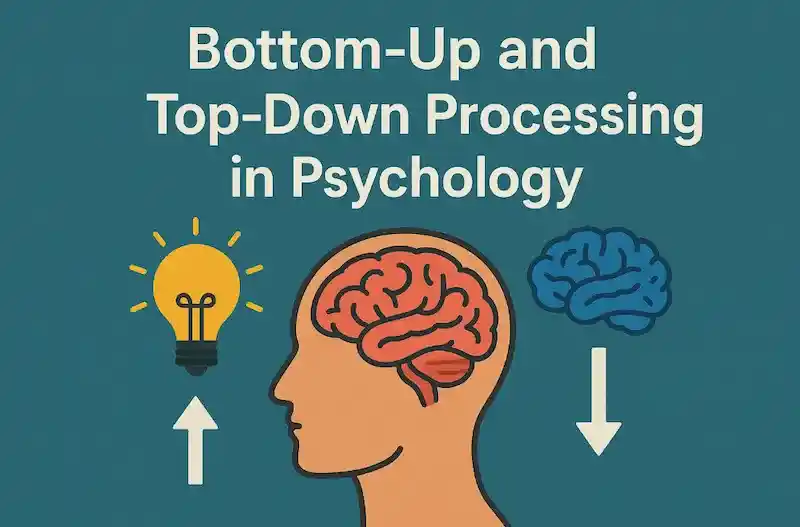
Table of Contents
Introduction
Imagine walking into your favorite neighborhood café on a Saturday morning. The first thing you notice is the rich, roasted aroma of freshly brewed coffee—sharp enough to pull you toward the counter. Then, you hear the clink of ceramic mugs, the murmur of friends laughing, and a barista calling out an order. Glancing across the room, you spot a familiar face waving: it’s your friend, even though their back is partially turned and the lighting is dim. How does your brain turn these disjointed sensory bits—smells, sounds, blurry shapes—into a clear, coherent experience? The answer lies in two fundamental cognitive mechanisms: bottom-up processing and top-down processing.
These two processes work in tandem to shape how we see, hear, taste, touch, and understand the world around us. While one relies on raw sensory data to build understanding from the “bottom” up, the other uses existing knowledge and context to guide interpretation from the “top” down. Together, they explain everything from how we read a messy handwritten note to how a radiologist spots a tumor in an X-ray.
In this guide, we’ll break down bottom-up processing and top-down processing with clear definitions, trace their history in psychology, explore their neural mechanisms, and share real-world examples of how they operate—alone and together. By the end, you’ll not only understand these core concepts but also recognize them in your daily life, from learning a new skill to navigating a crowded street.
What Are Bottom-Up and Top-Down Processing? Core Definitions
To grasp how we perceive the world, we first need to define the two building blocks of cognition: bottom-up processing and top-down processing. Each follows a distinct path, but their collaboration is what makes human perception efficient and flexible.
Bottom-Up Processing Definition Psychology: Data-Driven Perception
At its core, bottom-up processing is a “sensory-first” approach to cognition. It begins with raw input from your senses—light hitting your retina, sound waves entering your ears, or the texture of a fabric against your fingers—and builds upward to form a complete, meaningful perception. Think of it as your brain “reading” the world like a beginner reading a book: it starts with individual letters (sensory details), combines them into words (simple features), and eventually interprets sentences (complex ideas).
Crucially, bottom-up processing does not rely on prior knowledge, expectations, or context. It is purely driven by the data your senses collect. For example, if you’ve never seen a durian before, your brain will process its spiky texture, yellow color, and pungent smell step-by-step—without any preexisting ideas about what it is or how it tastes. This is why bottom-up processing is often called “data-driven processing”: the information comes directly from the world, not from your memory.
So, what is bottom up processing in simpler terms? It’s your brain’s way of saying, “Show me what you’ve got, and I’ll figure it out.” It’s the foundation of how we experience new things, as it lets us take in raw information without bias or assumptions.
Top-Down Processing Definition Psychology: Concept-Driven Perception
In contrast, top-down processing is a “knowledge-first” approach. It starts with what your brain already knows—memories, beliefs, expectations, or context—and uses that information to guide how you interpret sensory input. Instead of building understanding from the ground up, it filters and shapes raw data to fit what you already think or expect. A useful analogy is watching a movie: if you know it’s a horror film, you’ll interpret a creaky floorboard as a threat, not just a random sound—because your prior knowledge of the genre guides your perception.
Top-down processing is critical for resolving ambiguity. When sensory input is incomplete, blurry, or confusing, your brain uses context and experience to “fill in the gaps.” For example, if you see a sign that says “_ANK OF AMERICA,” you’ll instantly recognize it as “Bank of America”—even though the first letter is missing. Your knowledge of common bank names and the context of the sign (likely outside a financial building) lets you make that leap. This is why top-down processing is also called “concept-driven processing”: your preexisting concepts and schemas drive how you make sense of the world.
To answer the question, “what is top-down processing?” think of it as your brain’s shortcut. It saves time by using what it already knows to make sense of new information—turning chaotic sensory data into something familiar and meaningful.
A Brief History of Bottom-Up and Top-Down Processing in Psychology
The ideas behind bottom-up and top-down processing didn’t emerge overnight. They evolved over more than a century of psychological research, as scientists debated how the mind makes sense of the world. Let’s trace their origins and key milestones.
Early Foundations (Late 19th–Early 20th Century)
The story begins with two competing schools of thought: structuralism and Gestalt psychology—each laying groundwork for one of the two processing styles.
- Structuralism and Bottom-Up Roots: In the late 1800s, Wilhelm Wundt, often called the “father of experimental psychology,” founded structuralism. This school argued that perception could be broken down into tiny, basic “sensations” (e.g., the color red, the sound of a piano note) and “feelings” (e.g., pleasure, discomfort). Wundt believed that the mind built complex perceptions by combining these simple elements—exactly the linear, data-driven logic of bottom-up processing. For example, seeing an apple would involve combining sensations of red, roundness, and sweetness into a single experience. While structuralism later fell out of favor, its focus on sensory building blocks paved the way for modern understandings of bottom-up processing.
- Gestalt Psychology and Top-Down Shifts: By the early 1900s, Gestalt psychologists like Max Wertheimer, Wolfgang Köhler, and Kurt Koffka challenged structuralism. They argued that “the whole is greater than the sum of its parts”—meaning we perceive objects as unified wholes, not just collections of individual sensations. For example, if you see a series of disconnected dots arranged in a circle, you’ll perceive a full circle, not just dots. This is because your brain uses innate “organizational principles” (e.g., closure, similarity, proximity) to make sense of fragmented input—core ideas that would later become top-down processing. The Gestaltists showed that perception isn’t just about raw sensory data; it’s about how the mind interprets that data using built-in patterns and expectations.
The Cognitive Revolution (1950s–1960s): Formalizing the Concepts
The 1950s and 1960s marked the “cognitive revolution,” a shift away from behaviorism (which focused only on observable actions) to studying internal mental processes like attention, memory, and perception. During this era, researchers formalized the terms bottom-up and top-down processing and developed models to explain how they work.
- Donald Broadbent and Bottom-Up Attention: In 1958, psychologist Donald Broadbent proposed his “Filter Theory” of attention. He argued that the brain processes sensory input in a linear, bottom-up way: first, it receives all incoming information (e.g., multiple conversations at a party), then filters out irrelevant data based on physical features (e.g., the pitch of a voice), and finally processes the relevant information. Broadbent’s model was one of the first to explicitly describe bottom-up processing as a sequential, stimulus-driven process—shaping how we think about attention today.
- Frederic Bartlett and Schema Theory for Top-Down Processing: Around the same time, British psychologist Frederic Bartlett’s work on memory laid the groundwork for top-down processing. In his 1932 book Remembering, Bartlett asked participants to read a Native American folktale called “The War of the Ghosts” and then recall it later. He found that participants didn’t remember the story accurately—they changed details to fit their own cultural “schemas” (e.g., replacing “canoes” with “boats” or “spirits” with “ghosts”). Bartlett’s research showed that memory (and perception) is not just about storing raw data; it’s about using prior knowledge to interpret and reshape information—a key principle of top-down processing.
Contemporary Advances (1990s–Present)
In recent decades, advances in neuroscience (e.g., fMRI, EEG) have let researchers see bottom-up and top-down processing in action inside the brain. This research has confirmed that the two processes are not just theoretical—they have distinct neural pathways and work together dynamically.
- Neuroscience Validates the Two Processes: Studies show that bottom-up processing primarily activates primary sensory cortices (e.g., the visual cortex at the back of the brain, which processes light and shapes) and the thalamus (a “relay station” for sensory signals). In contrast, top-down processing activates higher-order brain regions like the prefrontal cortex (which handles decision-making and goals) and the hippocampus (which retrieves memories). For example, when you look at a cat, your visual cortex (bottom-up) processes its fur color and shape, while your prefrontal cortex (top-down) uses your memory of cats to confirm, “That’s a cat.”
- Integrated Models: Researchers like James McClelland and David Rumelhart also developed models that frame bottom-up and top-down processing as complementary, not opposing. Their 1981 “Interactive Activation Model” explained how we recognize letters and words: bottom-up signals (from individual letter features) and top-down signals (from word context) interact in a network of neurons, making recognition faster and more accurate. This model helped shift the field away from “either/or” thinking to understanding how the two processes work in tandem.
How Do They Work? The Mechanisms and Neural Basis
To truly understand bottom-up and top-down processing, we need to look at how they operate in the brain—step by step. Each process follows a distinct pathway, but their paths intersect to create seamless perception.
The Mechanism of Bottom-Up Processing
Bottom-up processing is a linear, sequential process that starts with your senses and moves upward to higher brain regions. Here’s how it works, using vision as an example (the most studied sensory system for these processes):
- Sensory Detection: It all begins with your sensory receptors. For vision, this means light waves hitting the retina (the thin layer of cells at the back of your eye). Specialized cells called rods and cones convert light into electrical signals—raw data about brightness, color, and contrast.
- Signal Relay to the Brain: These electrical signals travel from the retina through the optic nerve to the thalamus, the brain’s “sensory hub.” The thalamus filters out irrelevant signals (e.g., minor fluctuations in light) and sends the important ones to the primary visual cortex (V1), located at the back of the brain.
- Basic Feature Processing: In V1, neurons start breaking down the signal into simple features: edges (vertical, horizontal, diagonal), shapes (circles, squares), colors, and textures. For example, if you’re looking at a tree, V1 processes the edges of its branches and the green color of its leaves—one feature at a time.
- Higher-Order Integration: The processed features then move to higher visual cortices (e.g., V2, V4, and the temporal lobe). These regions combine the basic features into more complex objects. The temporal lobe, for instance, integrates the tree’s branches, leaves, and trunk into a single perception: “That’s a tree.”
Key brain regions for bottom-up processing include:
- Primary sensory cortices (visual, auditory, tactile, etc.): Process raw sensory input.
- Thalamus: Relays and filters sensory signals.
- Posterior parietal cortex: Helps with spatial attention, directing you to salient (noticeable) stimuli (e.g., a bright red bird in a green tree).
The Mechanism of Top-Down Processing
Unlike the linear path of bottom-up processing, top-down processing is a “predictive” process that starts in higher brain regions and flows downward to influence sensory processing. Let’s use the example of reading a messy note to illustrate:
- Goal or Context Activation: You pick up a note from a friend and see the words, “Meet me at the _ark at 3.” Your goal (meeting your friend) and context (a note from someone you know) activate the prefrontal cortex—the part of the brain responsible for goals, planning, and decision-making.
- Memory Retrieval: The prefrontal cortex signals the hippocampus (your brain’s memory center) to retrieve relevant knowledge: you know your friend often suggests parks for meetings, and common words that fit “_ark” (e.g., park, mark, dark) are stored in your memory.
- Predictions Sent to Sensory Cortices: Your brain sends a “prediction” to the primary visual cortex: “The missing letter is likely ‘p,’ making the word ‘park.’” This prediction primes the visual cortex to look for evidence that confirms it (e.g., a faint smudge that could be the curve of a “p”).
- Interpretation and Correction: The visual cortex processes the smudged letter and compares it to the prediction. Since the smudge matches the shape of a “p,” your brain confirms the word is “park.” If the smudge looked like an “m” instead, your brain would adjust the prediction (e.g., “Maybe it’s ‘mark’?”) and recheck—this is called “predictive coding.”
Key brain regions for top-down processing include:
- Prefrontal cortex: Guides attention and goals, initiates predictions.
- Hippocampus: Retrieves memories and schemas to inform predictions.
- Anterior cingulate cortex: Helps correct incorrect predictions (e.g., realizing the word is “mark” instead of “park” if the context changes).
Real-World Examples: Bottom-Up and Top-Down Processing in Action
The best way to understand bottom-up and top-down processing is to see them in everyday life. Below are examples across different senses, showing how each process works alone—and how they collaborate.
Bottom-Up Processing Examples Across Senses
Bottom-up processing is what lets us experience new things without prior knowledge. Here are three common examples:
- Visual Example: Seeing a New Type of Fruit: Suppose you’re at a grocery store and spot a fuzzy, orange fruit you’ve never seen before (a kiwano, or “horned melon”). Your eyes first process its basic features: the orange color, the spiky texture, and its oval shape. These features are sent to your visual cortex, which combines them into a “new object” perception. You don’t know what it is yet—you’re just taking in the raw data. This is pure bottom-up processing: no prior knowledge guides your perception; you’re building understanding from the sensory details up.
- Auditory Example: Hearing a New Song: When you listen to a song for the first time, your ears detect individual notes, the rhythm of the drums, and the singer’s voice—one sound at a time. Your auditory cortex processes these raw sound waves, combining them into a melody and lyrics. You don’t know the song’s meaning or how it will end; you’re just absorbing the audio input. This is a classic bottom-up processing example: the music drives your perception, not your expectations.
- Taste Example: Trying a New Dish: You’re at a Thai restaurant and order “khao soi”—a coconut curry noodle soup you’ve never tasted. Your taste buds first detect basic flavors: the sweetness of coconut, the spiciness of chili, and the saltiness of soy sauce. Your tongue also processes the texture: creamy broth, chewy noodles, and crispy fried onions. These sensory details are sent to your gustatory cortex (which handles taste) and somatosensory cortex (which handles texture), where they’re combined into a single experience: “This is a spicy, creamy noodle soup.” No prior experience with khao soi is needed—this is bottom-up processing in action.
Top-Down Processing Examples Across Senses
Top-down processing is what lets us make sense of ambiguous or incomplete information. Here are three everyday examples:
- Visual Example: Reading a Faded Menu: You’re at a diner with a menu that’s been used for years—some words are faded. You see “_amburger with fries” and instantly know it’s “Cheeseburger with fries.” Why? Your context (a diner, where cheeseburgers are a common item) and prior knowledge (you’ve seen “cheeseburger” written hundreds of times) let you fill in the missing “C” and “heese.” This is top-down processing: your existing knowledge guides your interpretation of the faded text.
- Auditory Example: Conversing in a Loud Bar: You’re talking to a friend at a crowded bar, and the music is so loud you can’t hear every word. Your friend says, “Do you want to ___ to my place after?” Even though the middle word is muffled, you know you’re discussing post-bar plans, so you guess the word is “come.” Your context (the bar, planning next steps) and knowledge of common phrases let you fill in the gap. This is a clear top-down processing example: your brain uses context to make sense of incomplete audio.
- Touch Example: Finding Your Phone in a Bag: You’re rushing out the door and need your phone, but your bag is full of items—keys, lip balm, a notebook. You reach in without looking and instantly find your phone. How? You remember your phone’s texture (smooth screen, slightly curved edges) and weight, so your fingers ignore other items that don’t match that “profile.” Your prior knowledge of your phone’s feel guides your touch perception—this is top-down processing.
Combined Examples: When Bottom-Up and Top-Down Work Together
Most of the time, bottom-up and top-down processing work in tandem to create efficient, accurate perception. Here are two critical examples of their collaboration:
- Medical Imaging: Radiologists Reading X-Rays: A radiologist’s job relies on both processes. First, they use bottom-up processing to scan the X-ray for raw sensory details: faint shadows, unusual densities, or irregular shapes in the bones or organs. For example, they might notice a small, dark spot on a lung. Then, they switch to top-down processing: they use their knowledge of lung anatomy, common diseases (e.g., pneumonia, tumors), and the patient’s history (e.g., “smoker for 20 years”) to interpret the spot. Is it a harmless cyst, or a sign of something serious? Without bottom-up input, they’d have no details to analyze; without top-down knowledge, they’d misinterpret the spot. This is one of the most important bottom up and top down processing examples in healthcare—lives depend on their balance.
- Learning a New Language: Mastering Vocabulary: When you first learn a new word (e.g., the Spanish word “perro”), you use bottom-up processing to parse the sound: you hear “peh-roh” and process each syllable. You also use bottom-up to recognize the word when you see it written, focusing on the letters “p-e-r-r-o.” As you practice, top-down processing takes over: when you see “perro” in a sentence (“El perro corre”), you use your knowledge of Spanish grammar (e.g., “el” means “the”) and context (the sentence is about something running) to confirm it means “dog.” Over time, the two processes work together to make “perro” feel as familiar as the English word “dog”—showing how bottom-up and top-down processing support learning.
The Dynamic Interaction: How Bottom-Up and Top-Down Processing Collaborate
Bottom-up and top-down processing are not rivals—they’re partners. Their interaction is dynamic, meaning the brain shifts the balance between them based on context, task, and experience. Let’s explore how they complement each other and when one takes the lead.
Complementarity: Filling Each Other’s Gaps
The biggest strength of their collaboration is that they fix each other’s weaknesses. Bottom-up processing excels at providing specific, detailed sensory data—but it can be slow and overwhelming if left alone. Imagine trying to read a book by focusing on every single letter: you’d never get through a sentence. Top-down processing solves this by providing context and expectations—speeding up interpretation—but it can be biased if it ignores sensory details. For example, if you expect a friend to be at a party, you might mistake a stranger with a similar haircut for them—until bottom-up details (e.g., their voice, their clothes) correct the error.
A perfect example of this complementarity is driving. When you’re on a familiar route, top-down processing dominates: you use your memory of the road to anticipate turns, stop signs, and traffic patterns. But if a deer suddenly runs into the road (a unexpected bottom-up stimulus), your brain instantly shifts to bottom-up processing—focusing on the deer’s shape and movement to hit the brakes. Without top-down knowledge, you’d struggle to navigate; without bottom-up awareness, you’d miss critical hazards.
Context-Dependent Balance: Which Process Dominates When?
The brain doesn’t use bottom-up and top-down processing equally in all situations. It adjusts the balance based on three factors: the clarity of sensory input, your goals, and your familiarity with the task.
- Clear Sensory Input: Bottom-Up Dominates: When sensory data is clear and unambiguous, bottom-up processing takes the lead. For example, if you’re looking at a bright, in-focus photo of a cat in good lighting, your brain doesn’t need to rely on expectations— the details (fur, eyes, whiskers) are so clear that bottom-up processing is enough to recognize it as a cat.
- Ambiguous or Scarce Input: Top-Down Dominates: When sensory data is blurry, faded, or incomplete, top-down processing takes over. For example, if you’re trying to read a menu in a dimly lit restaurant, the text is hard to see—so you use your knowledge of common menu items (e.g., “steak,” “salad”) to guess faded words. Similarly, if you hear a faint sound in the dark, you’ll use context (e.g., “I’m in my house”) to interpret it as a creaky floorboard, not a threat—unless the sound is unusual, which would shift back to bottom-up attention.
- Goal-Directed Attention: Top-Down Guides Focus: When you have a specific goal, top-down processing directs your attention to relevant sensory input. For example, if you’re grocery shopping for milk, you’ll ignore cookies, chips, and other snacks (even if they’re visually striking) and focus on the dairy aisle. Your goal (“find milk”) activates top-down mechanisms that prioritize milk-related sensory details (e.g., the color of milk cartons, the word “milk” on labels) over irrelevant ones.
Neuroplasticity: How Experience Shapes the Balance
Your brain’s ability to shift between bottom-up and top-down processing isn’t fixed—it changes with experience. This is called neuroplasticity: the brain’s ability to rewire itself based on learning and practice.
For example, consider a beginner vs. an expert bird watcher. A beginner uses mostly bottom-up processing to identify a bird: they look at every feature (color, size, beak shape) one by one, comparing it to a field guide. An expert, however, uses mostly top-down processing: they’ve seen thousands of birds, so they can recognize a sparrow in a split second by its silhouette or flight pattern—without needing to analyze every detail. Their brain has rewired itself to use top-down knowledge to speed up perception.
Another example is learning to play a musical instrument. When you first learn to play the piano, you use bottom-up processing to find each key, reading sheet music one note at a time. After months of practice, you use top-down processing: you recognize chords and melodies instantly, relying on muscle memory and knowledge of the song to play without looking at every note. This shift from bottom-up to top-down is a result of neuroplasticity—your brain adapts to make the task more efficient.
Applications: Bottom-Up and Top-Down Processing Beyond Psychology
The ideas of bottom-up and top-down processing aren’t just theoretical—they have practical applications in fields like technology, education, and healthcare. Understanding these processes helps us design better tools, teach more effectively, and treat cognitive disorders.
Machine Learning & Artificial Intelligence (AI)
AI and machine learning researchers often draw inspiration from human cognition—including bottom-up and top-down processing—to build smarter systems.
- Bottom-Up in AI: Computer vision models (used in self-driving cars, facial recognition, and photo apps) rely on bottom-up processing to detect objects. For example, a self-driving car’s camera first processes basic features of the road (edges of lanes, colors of traffic lights) using algorithms that mimic the primary visual cortex. These features are then combined to recognize stop signs, pedestrians, and other cars—just like bottom-up processing in humans.
- Top-Down in AI: Modern AI models like Transformers (used in ChatGPT and other language models) use top-down “attention mechanisms” to understand context. For example, when ChatGPT reads a sentence like “The cat chased the mouse,” it uses top-down context to know that “it” in the next sentence (“It ran under the couch”) refers to the mouse, not the cat. This is similar to how human top-down processing uses context to resolve pronouns.
By combining bottom-up feature detection with top-down context, AI systems become more accurate and human-like. For example, a medical AI that reads X-rays uses bottom-up to spot shadows and top-down to compare those shadows to a database of known diseases—just like a radiologist.
Education & Learning Design
Teachers and curriculum designers use bottom-up and top-down processing to create more effective learning experiences for students.
- Bottom-Up Strategies for Foundational Skills: For young learners or those mastering new basics (e.g., reading, math), bottom-up approaches work best. For example, teaching phonics (breaking words into sounds like “c-a-t” for “cat”) helps children build reading skills from the ground up—using bottom-up processing to connect letters to sounds. Similarly, teaching addition by counting physical objects (e.g., blocks) helps kids understand numbers through sensory input.
- Top-Down Strategies for Advanced Learning: For older students or complex topics (e.g., literature, science), top-down approaches are more effective. For example, asking students to predict the theme of a novel based on its title (e.g., To Kill a Mockingbird) activates top-down processing—using prior knowledge of racism, justice, and coming-of-age stories to guide their reading. In science, teaching a lab by first explaining the hypothesis (e.g., “Plants need sunlight to grow”) lets students use top-down expectations to interpret their observations (e.g., “The plant in the dark is wilting”).
Balancing both strategies is key. For example, a language teacher might start with bottom-up drills (vocabulary, grammar) and then move to top-down activities (conversations, reading stories)—helping students build skills and then apply them in context.
Clinical Psychology & Neuroscience
Disorders of perception and attention often involve an imbalance between bottom-up and top-down processing. Understanding this imbalance helps clinicians diagnose and treat these conditions.
- ADHD and Top-Down Deficits: People with Attention Deficit Hyperactivity Disorder (ADHD) often struggle with top-down processing. Their prefrontal cortex (which guides top-down attention) is less active, making it hard to ignore distractions (e.g., a bird outside the window during class) and focus on goals (e.g., finishing homework). Treatment options like behavioral therapy or medication aim to strengthen top-down control, helping patients prioritize relevant information.
- Autism Spectrum Disorder (ASD) and Bottom-Up Overactivity: Some individuals with ASD have stronger bottom-up processing and weaker top-down processing. They may be hyper-sensitive to sensory input (e.g., loud noises, bright lights) because their brain can’t use top-down context to filter out irrelevant details. They may also struggle to interpret social cues (e.g., a smile) because they focus on small features (e.g., the shape of lips) instead of using top-down knowledge of social norms. Therapies that teach social skills help strengthen top-down processing, making it easier to interpret context.
- Schizophrenia and Predictive Coding Errors: People with schizophrenia often have trouble with top-down predictive coding. Their brain makes incorrect predictions about sensory input, leading to hallucinations (e.g., hearing voices) or delusions (e.g., thinking others are watching them). For example, a rustling leaf might be misinterpreted as a voice—because the brain’s top-down predictions are distorted. Medications and therapy help restore balance between bottom-up sensory input and top-down predictions.
Common Misconceptions About Bottom-Up and Top-Down Processing
Despite their importance, bottom-up and top-down processing are often misunderstood. Let’s clear up three common myths.
Misconception 1: “They Are Opposing, Not Collaborative”
One of the biggest myths is that bottom-up and top-down processing are opposites—like two sides of a coin that can’t be used at the same time. But as we’ve seen, this is far from true. Most perceptions involve both processes working together. For example, when you talk to a friend, you use bottom-up to process their voice and top-down to understand their words in context. Even simple tasks like recognizing a face require bottom-up (processing facial features) and top-down (using memory to confirm it’s your friend). Modern research confirms that the brain uses a “hybrid” model—both processes interact constantly to create seamless perception.
Misconception 2: “Top-Down Processing Is ‘Biased,’ So It’s Less Reliable”
Critics sometimes argue that top-down processing is biased because it uses prior knowledge to interpret sensory input. While it’s true that top-down can lead to biases (e.g., stereotyping someone based on appearance), this doesn’t make it unreliable—it makes it efficient. Without top-down processing, we’d be overwhelmed by sensory data. For example, if you had to process every letter of every word you read, you’d read at a snail’s pace. Top-down biases are often helpful: assuming a “_ark” sign means “Bank” saves time and keeps you from getting lost. The brain also uses bottom-up input to correct biased top-down predictions (e.g., realizing the sign says “Park” instead of “Bank” when you see trees nearby).
Misconception 3: “One Process Is More Important Than the Other”
Another myth is that one process is “better” or more important than the other. But their importance depends on the task. For learning new skills (e.g., playing an instrument), bottom-up processing is critical—you need to master the basics before you can use top-down knowledge. For complex tasks (e.g., medical diagnosis), both are equally important—you need bottom-up to spot details and top-down to interpret them. In short, bottom-up processing is the “foundation” of perception, and top-down processing is the “shortcut”—you need both to function effectively.
Conclusion: Why Understanding These Processes Matters
Bottom-up and top-down processing are the invisible engines of human perception. They explain how we turn chaotic sensory input into meaningful experiences—whether we’re reading a book, talking to a friend, or navigating a busy street. By understanding these processes, you can:
- Notice them in daily life: Next time you taste a new food, read a messy note, or listen to a song, ask yourself: Is my brain using bottom-up (processing raw details) or top-down (using context) to make sense of this?
- Learn more effectively: Use bottom-up strategies to master basics (e.g., flashcards for vocabulary) and top-down strategies to apply knowledge (e.g., writing essays to practice grammar).
- Be more aware of biases: Recognize when top-down expectations are shaping your perception (e.g., assuming someone is unfriendly based on their expression) and use bottom-up details (e.g., their kind words) to correct those biases.
As research advances, we’re learning more about how these processes interact—from the neural pathways in the brain to their applications in AI and healthcare. But one thing is clear: bottom-up and top-down processing are not just abstract concepts—they’re the way we experience the world.
The next time you walk into that café, take a moment to appreciate the magic of these processes: the bottom-up smell of coffee, the top-down recognition of your friend’s face, and the way they work together to make that moment feel effortless. That’s the power of human cognition—and it’s all thanks to bottom-up and top-down processing.
References
- Goldstein, E. B. (2022). Cognitive Psychology: Connecting Mind, Research, and Everyday Experience (9th ed.). Cengage. This textbook provides a comprehensive overview of bottom-up and top-down processing, including their definitions, neural mechanisms, and real-world examples.
- Broadbent, D. E. (1958). Perception and Communication. Pergamon Press. Donald Broadbent’s classic work introduces the Filter Theory of attention, laying the groundwork for modern understanding of bottom-up processing.
- Bartlett, F. C. (1932). Remembering: A Study in Experimental and Social Psychology. Cambridge University Press. Frederic Bartlett’s research on memory and schemas is a foundational text for understanding top-down processing in cognition.
- McClelland, J. L., & Rumelhart, D. E. (1981). An interactive activation model of context effects in letter perception. Psychological Review, 88(5), 375–407. This paper presents the Interactive Activation Model, which explains how bottom-up and top-down processing interact in word recognition.
- Kveraga, K., Ghuman, A. S., & Bar, M. (2007). Top-down predictions in the cognitive brain. Brain and Cognition, 65(2), 145–168. This study explores the neural basis of top-down predictive processing, using fMRI to show how higher brain regions influence sensory perception.
- Driver, J., & Vuilleumier, P. (2001). Perceptual awareness and its loss in unilateral neglect and extinction. Cognition, 79(1-2), 39–88. This article discusses how bottom-up and top-down processing imbalances contribute to clinical conditions like unilateral neglect (a disorder where patients ignore one side of their body or environment).
- Friston, K. (2005). A theory of cortical responses. Philosophical Transactions of the Royal Society B: Biological Sciences, 360(1456), 815–836. Karl Friston’s work on predictive coding provides a theoretical framework for understanding how top-down predictions shape bottom-up sensory processing.






I consider something genuinely special in this internet site.
Great job on this
Strongly written